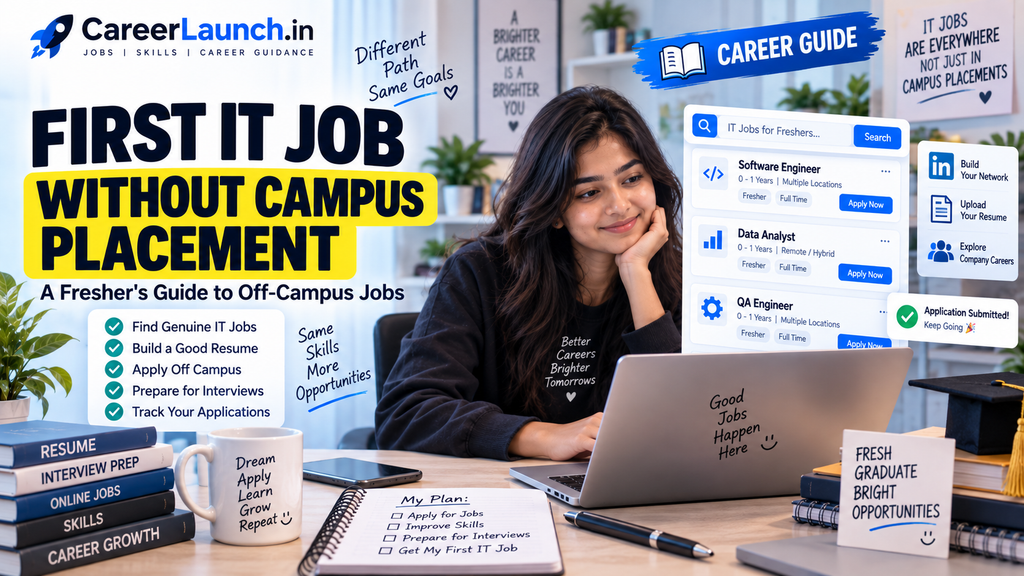
First IT Job Without Campus Placement – A Complete Fresher’s Guide
Getting a job through campus placement is one of the easiest ways for a college student to start their career. Your college brings companies to campus, you attend tests and interviews, and the placement team helps with the process.
But what if you did not get placed?
Maybe the companies that visited your college were not hiring for your preferred role. Maybe you did not clear the placement test. Or maybe your college had very few IT companies visiting the campus.
That does not mean your IT career is over.
Many freshers start their careers through off-campus hiring. You can search for jobs directly through company career pages, LinkedIn, job platforms, referrals and other genuine sources.
In this guide, we will look at how you can find your First IT Job Without Campus Placement, what you should prepare, where you should apply and what mistakes you should avoid for First IT Job Without Campus Placement.
Is It Possible to Get an IT Job Without Campus Placement?
Yes.
Campus placement is only one way to get your first job. Companies also hire candidates through their official career websites, LinkedIn, job portals, referrals, hiring drives and assessment-based hiring.
For example, a company may post an opening for a fresher Software Engineer on its website. You can apply directly, complete the assessment and attend the interview if you are shortlisted.
You do not need your college to be involved in the process.
The main difference is that when you search for your First IT Job Without Campus Placement, you have to take more responsibility for finding opportunities and tracking your applications for First IT Job Without Campus Placement.
That may sound difficult at first, but it becomes easier once you have a routine for getting First IT Job Without Campus Placement.
1. Decide What Type of IT Job You Want
Before applying everywhere, first decide what kind of role you are looking for.
As a fresher, you do not need to have your entire career planned. You only need a reasonable starting direction to get your First IT Job Without Campus Placement.
Some common entry-level IT roles include:
Software Developer
Associate Software Engineer
Programmer Analyst
Data Analyst
QA or Testing Engineer
Technical Support Associate
Business Analyst
Application Support Associate
Web Developer
Database or SQL Developer
Your choice should depend on your degree, skills, projects and interests.
For example, if you have learned Python and SQL and completed a data analysis project, you can look for entry-level Data Analyst roles instead of applying randomly to every IT position.
Having a target role also makes your resume and preparation more focused.
2. Start With Official Company Career Pages
One of the best ways to find genuine off-campus opportunities is through the company’s official careers website.
Make a list of companies that regularly hire freshers and check their career pages.
Look for keywords such as:
Fresher
Graduate
Entry Level
Trainee
Associate
Junior
0-1 years
0-2 years
Software Engineer
You can also search for a particular role followed by “careers” or “jobs.”
For example, if you want to become a software developer, you can search for:
Software Engineer Fresher Jobs
Then check whether the opening is available on the company’s official website.
This is especially useful because you are applying through the employer’s own hiring system rather than depending completely on a third-party post.
3. Use LinkedIn to Find Off-Campus Jobs
LinkedIn is another useful platform for freshers to get your First IT Job Without Campus Placement.
Create a professional profile and clearly mention your education, skills, projects and internship experience.
You can search for terms such as:
Fresher Software Engineer
Graduate Developer
Associate Software Engineer
Entry Level Data Analyst
QA Fresher
IT Support Fresher
Follow companies that interest you and turn on relevant job alerts.
You can also follow recruiters and hiring teams, but remember that not every message or job post on social media is genuine.
Always verify important job details before sharing personal information or completing an application.
4. Keep Your Resume Ready
Your resume is one of the most important things you need when searching for your first job.
Do not wait until you find a job opening to create your resume.
Keep one good master resume ready and make small changes according to the role.
For a fresher, your resume can include:
Name and contact details
Professional summary
Education
Technical skills
Projects
Internship experience
Certifications
Relevant achievements
GitHub or portfolio link
Try to keep the resume simple and easy to read.
You do not need to list every technology you have ever studied.
For example, if you are applying for a Python developer role, make sure your Python projects and relevant technical skills are easy to find.
If you are applying for a Data Analyst role, highlight SQL, Excel, Python, data analysis and relevant projects if those skills match the job description.
5. Read the Job Description Carefully
One of the biggest mistakes freshers make is applying for a job without reading the complete job description.
Before applying, check the basic requirements.
Check your qualification
Does the company require B.Tech, B.E., BCA, MCA or another degree?
Check the graduation year
Some companies specifically mention eligible batches such as 2025, 2026 or 2027.
Check experience
If the job says 0-1 years, freshers may be eligible. If it asks for several years of experience, it may not be suitable for you.
Check skills
Compare your current skills with the important skills mentioned in the job description.
Check location
Some jobs are work from office, while others may be hybrid or remote.
Check shifts
Some entry-level roles may require rotational or night shifts.
Taking five minutes to check these details can prevent you from wasting time on unsuitable applications.
6. Do Not Apply to Every Job You See
When you are unemployed or waiting for your first opportunity, it can be tempting to apply to everything while getting your First IT Job Without Campus Placement.
But applying to 100 random jobs is not always better than applying to 10 suitable jobs.
Suppose a company is hiring a Java Developer and the job requires strong Java knowledge, Spring Boot and SQL.
If you have only learned basic HTML and CSS, applying may not be the best use of your time.
Instead, find roles that match your current profile.
A good approach is:
Find the job -> Read the requirements -> Check your eligibility -> Customize your resume -> Apply -> Track the application
This makes your job search more organized.
7. Build Projects That You Can Explain
Projects are especially important when you are searching for your First IT Job Without Campus Placement because you may not have much professional experience.
You do not need ten projects.
Two or three meaningful projects are usually more useful than a long list of small copied projects.
For example, you could build:
A Python automation project
A simple web application
A SQL data analysis project
A machine learning project
An expense tracker
A student management system
A portfolio website
The important thing is to understand what you built.
During an interview, the interviewer may ask:
Why did you build this project?
Which technologies did you use?
What was your role?
What problem does it solve?
What difficulties did you face?
How would you improve it?
If you can answer these questions confidently, your project becomes much more useful.
8. Keep Your GitHub Profile Updated
If you are applying for technical roles, a GitHub profile can help you showcase your work.
You can upload your own projects and organize your repositories properly.
Add a simple README explaining:
What the project does
Technologies used
Main features
How to run it
What you learned
Do not upload copied projects from YouTube or GitHub and present them as your own.
If you used a tutorial to learn something, improve the project or create your own version and be honest about your learning process.
Your GitHub profile does not need hundreds of repositories.
A few genuine projects that you can explain are more valuable.
9. Prepare for Online Assessments
Many fresher hiring processes include an online assessment before the interview.
Depending on the role, you may get questions on:
Aptitude
Logical reasoning
Coding
SQL
English
Computer fundamentals
Role-specific technical topics
If you are targeting software roles, practice basic programming regularly.
If you are targeting data-related roles, focus on SQL, Excel, Python and basic data concepts where relevant.
Do not wait until you receive an assessment link.
Spend some time preparing while you are applying.
10. Improve Your Communication Skills
Technical skills are important, but communication also matters during interviews.
You should be able to explain your education, projects, skills and career interests clearly.
Start with a simple introduction.
For example:
“I recently completed my degree in Computer Science. I have worked on projects using Python and SQL, and I am currently looking for an entry-level opportunity where I can apply my technical skills and learn from a professional team.”
You do not need to use complicated English.
Clear and confident communication is more important.
Practice explaining your projects aloud. You can also record yourself answering common interview questions and listen to the recording later.
11. Use Referrals Carefully
Referrals can be useful when searching for off-campus jobs.
You can reach out to:
College seniors
Alumni
Friends working in IT
Former internship colleagues
Professional LinkedIn connections
Keep your message short and respectful.
For example:
“Hi, I noticed that your company is hiring for an entry-level Software Engineer role. I recently completed my degree and the role matches my skills. If you are comfortable, could you please refer me for the position?”
A referral does not guarantee a job.
You still need to meet the company’s requirements and clear the selection process.
12. Track Every Application
When you start applying regularly, it becomes difficult to remember where you applied.
Create a simple spreadsheet with columns such as:
Company
Role
Date Applied
Location
Status
Company A
Software Engineer
Sept 10
Bangalore
Applied
Company B
Data Analyst
Sept 11
Hyderabad
Assessment
Company C
QA Engineer
Sept 12
Pune
Waiting
You can also add the job link, application ID and assessment date.
This prevents you from applying to the same job repeatedly and helps you keep track of follow-ups.
13. Be Careful With Fake Job Offers
Unfortunately, freshers can become targets for fake job offers.
Be especially careful if someone promises a guaranteed job in exchange for money.
Avoid paying random people for:
Registration
Interview scheduling
Security deposits
Job confirmation
Guaranteed placement
Offer letter processing
Always verify the company and job opening.
If you find a job through social media, check whether the same position exists on the official company careers page.
Never share sensitive financial information with an unknown person simply because they claim to be a recruiter.
14. What If You Keep Getting Rejected?
Rejection is a normal part of the fresher job search.
You may apply to 20 jobs and hear back from only a few.
Do not immediately assume that you are not good enough.
Instead, look for patterns.
If you are getting rejected before assessments, check whether your resume matches the job requirements.
If you are failing coding tests, spend more time practicing programming.
If you are reaching interviews but not clearing them, work on communication and technical interview preparation.
If you are getting very few relevant openings, consider adding another suitable role to your job search.
The goal is not to avoid every rejection. The goal is to learn from the process.
15. Create a Daily Routine
Searching for your First IT Job Without Campus Placement can become stressful when every day feels the same.
A simple routine can help.
For example:
1 hour – Job search and applications
1 hour – Coding or technical preparation
1 hour – Project work
30 minutes – Interview preparation
15 minutes – LinkedIn and career updates
You do not have to follow these exact timings.
The main idea is to divide your day between applying, learning and preparing.
Do not spend the entire day refreshing job websites.
What If You Already Have a Job Offer But Are Waiting for Joining?
This is also common among fresh graduates.
If you already have an offer but your joining date has not arrived, use the waiting period productively.
Continue improving your technical skills, practice interview questions and work on small projects.
You can also keep an eye on other opportunities until your joining situation becomes clear.
However, always be honest about your existing offer when a company specifically asks about it.
A Simple Plan for Freshers
If you are starting your off-campus search today, follow this simple plan.
Week 1
Create or improve your resume.
Update your LinkedIn profile.
Create a professional GitHub profile.
Choose one or two target job roles.
Week 2
Start applying to suitable openings.
Practice technical questions.
Improve one project.
Start tracking your applications.
Week 3
Practice aptitude or coding assessments.
Prepare common HR questions.
Practice explaining your projects.
Reach out to relevant connections for referrals.
Week 4
Review your applications.
Identify where you are struggling.
Improve your resume if necessary.
Continue applying and preparing.
You do not need to follow this exact four-week plan. It is simply a starting point to make your job search more organized.
Final Thoughts
Not getting campus placement can feel disappointing, especially when you see your classmates receiving offers.
But your college placement is not the only path to a career in IT.
With the right approach, you can build your skills, find suitable openings and apply directly to companies.
The process may take time, and you may face several rejections before receiving your first offer. That is normal.
If you are searching for your First IT Job Without Campus Placement, focus on four things: find relevant jobs, apply with a good resume, keep improving your skills and prepare for the selection process.
Do not compare your journey with someone else’s.
Your first job may come through campus placement, an online application, LinkedIn, a referral or a hiring drive. The route can be different for everyone.
What matters is that you keep moving forward.
Your first IT job is only the beginning. Once you enter the industry, you will have many more opportunities to learn, switch roles, build experience and grow your career.