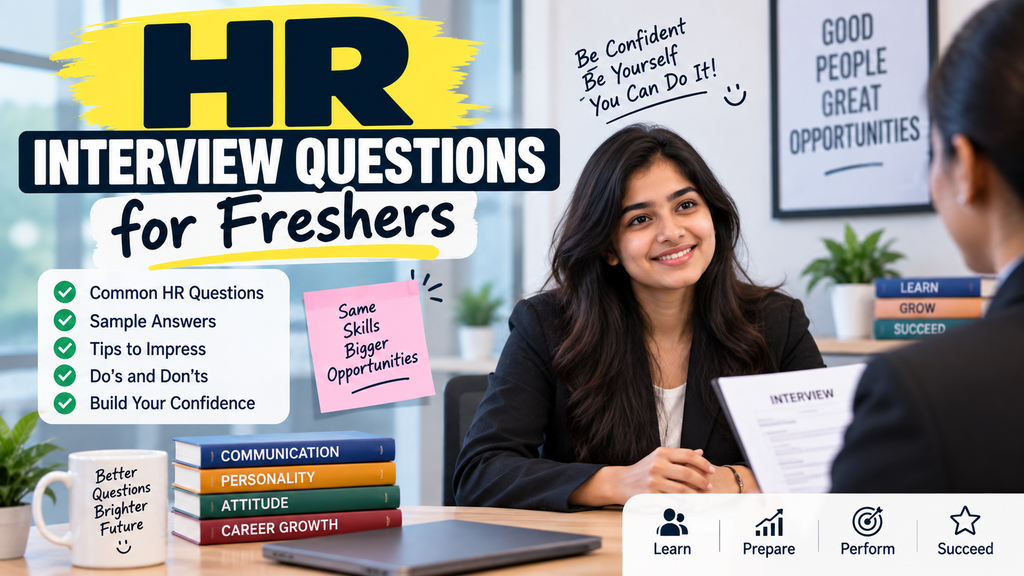
HR Interview Questions for Freshers: 20 Questions and Simple Answers
Getting an interview call is exciting, but the next part can make many freshers nervous.
You have updated your resume, applied for jobs and finally received an interview invitation. Then the interviewer starts with:
“Tell me about yourself.”
After that, you may hear questions like:
Why should we hire you?
What are your strengths?
What are your weaknesses?
Why do you want to join our company?
Where do you see yourself in five years?
These questions may look simple, but your answers can tell the interviewer a lot about your communication, confidence, attitude and career goals.
The good thing is that you don’t need to memorize complicated answers.
In this guide, we’ll look at some of the most common HR interview questions for freshers and how you can approach them.
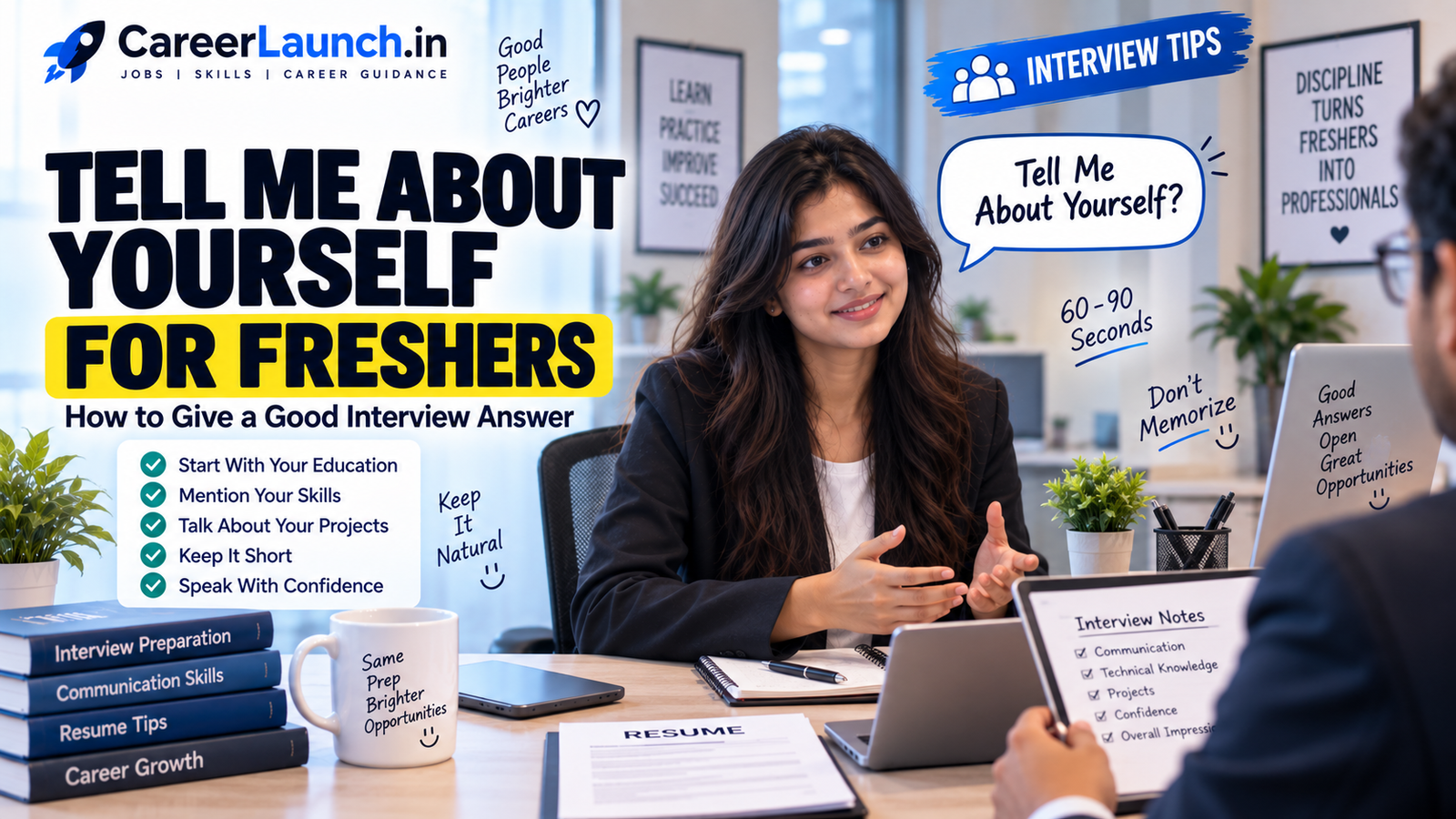
1. Tell Me About Yourself
This is one of the first questions you may hear in an interview.
The interviewer is not asking for your complete life story.
They want a short introduction about your education, skills, projects and career interests.
How to answer
A simple structure is:
Name → Education → Skills → Project/Experience → Career goal
Sample answer
“Hi, I’m Rahul. I recently completed my B.Tech in Computer Science. During my studies, I developed an interest in software development and worked with Java, Python and SQL. I also worked on a college project where I built a small web application with my team. Through the project, I got a chance to improve my technical and problem-solving skills. I’m now looking for an opportunity where I can use what I’ve learned and continue developing my skills.”
Don’t memorize this exact answer.
Change it according to your own education, skills and project.
2. Why Should We Hire You?
This question can make freshers uncomfortable because you may think:
“I don’t have any work experience. What should I say?”
You don’t need to compare yourself with other candidates.
Talk about what you can bring to the role.
Sample answer
“As a fresher, I may not have professional experience yet, but I have built a good foundation through my studies and projects. I’m willing to learn, I take feedback seriously and I’m comfortable putting in the effort to understand new things. I believe I can learn the role quickly and contribute as I gain more experience.”
This sounds much better than simply saying:
“You should hire me because I’m hardworking.”
Try to give a reason behind your answer.
3. What Are Your Strengths?
Pick strengths that are actually true about you.
Some examples include:
Quick learner
Good communication
Problem-solving
Teamwork
Time management
Attention to detail
Willingness to learn
Adaptability
Sample answer
“One of my strengths is that I’m comfortable learning things on my own. When I come across something I don’t understand, I usually try to learn it through documentation, tutorials and practice before asking for help.”
This is stronger than listing five strengths without explaining any of them.
4. What Is Your Weakness?
This is a tricky question.
You don’t need to say something that makes you look unsuitable for the job.
At the same time, saying:
“I don’t have any weaknesses.”
is usually not a good answer.
Instead, mention something genuine that you are working to improve.
Sample answer
“Earlier, I used to spend too much time trying to make small details perfect. I’ve been working on managing my time better and focusing on completing important tasks first.”
The important part is showing that you recognize the weakness and are doing something about it.
5. Why Do You Want to Join Our Company?
Before your interview, spend some time researching the company.
Look at:
What the company does
Its products or services
The role you’re applying for
The skills mentioned in the job description
Recent company updates
Then connect that information with your career goals.
Sample answer
“I’m interested in this opportunity because the role matches the skills I’ve been developing, especially in Python and SQL. I also like that the position would give me an opportunity to work on real projects and learn from an experienced team.”
Try not to give an answer that could apply to every company.
6. Why Did You Choose Your Degree?
The interviewer may ask this to understand your interest in your field.
Sample answer
“I chose Computer Science because I was interested in technology and wanted to understand how software and applications are built. During my degree, that interest grew when I started working on programming and database projects.”
If you chose your degree for a different reason, be honest.
Your answer doesn’t need to sound perfect.
7. Why Do You Want This Job?
Try to connect three things:
Your skills + the job + your career goal
For example:
“I’m interested in this role because it matches the skills I’ve been developing and gives me an opportunity to start my career in an area I’m genuinely interested in. I also see it as a good opportunity to learn from experienced people and work on real-world problems.”
8. Are You Willing to Relocate?
This is a common question, especially for freshers joining companies with offices in different cities.
There is no “correct” answer.
If you’re comfortable relocating, say so.
If you have limitations, be honest.
If you are comfortable:
“Yes, I’m comfortable relocating if the role requires it.”
If you have a limitation:
“I’m open to relocation, although I would prefer locations where I can manage my personal commitments. I’m happy to discuss the options.”
Don’t agree to something you know you cannot do.
9. Are You Comfortable Working in Shifts?
Some IT jobs involve rotational shifts, night shifts or weekend support.
If the job description mentions shifts, be prepared for this question.
Sample answer
“Yes, I’m comfortable working in shifts if the role requires it. I understand that some IT operations and support teams need coverage outside regular working hours.”
If you genuinely cannot work certain shifts, don’t lie just to get through the interview.
10. Where Do You See Yourself in Five Years?
The interviewer usually wants to know whether you have some direction for your career.
You don’t need to predict your exact job title five years from now.
Focus on skills and growth.
Sample answer
“Over the next five years, I want to become strong in my technical area and take on more responsibility. I would like to work on real projects, improve my problem-solving skills and gradually become someone the team can depend on.”
This is much more realistic for a fresher than saying:
“I want to become the CEO.”
11. What Are Your Salary Expectations?
This question can be difficult for freshers because you may not know the market range.
If the company has already mentioned a salary range, you can refer to it.
Sample answer
“As a fresher, my main priority is getting the right opportunity to learn and build my career. I’m open to the company’s standard compensation for this role.”
If they ask you for a specific number, give a reasonable range based on the role, location and market rather than choosing a random figure.
12. Are You a Team Player?
Most jobs involve working with other people, so this is a common HR question.
Don’t just say “yes.”
Give a small example.
Sample answer
“Yes. During my final-year project, I worked with a team where we divided the work between us and had regular discussions about our progress. I learned that communicating early is important when there is a problem because it gives the team more time to solve it.”
A simple college project can be enough for a fresher.
13. How Do You Handle Pressure?
Interviewers don’t expect a fresher to have experience handling major workplace pressure.
You can talk about college projects, exams or deadlines.
Sample answer
“When I have multiple tasks, I first list them based on their priority and deadline. I then work on the important tasks first instead of trying to do everything at the same time. During college projects, this helped me manage deadlines more effectively.”
14. How Do You Handle Failure?
Nobody expects you to say that you’ve never failed.
A better answer shows that you learn from mistakes.
Sample answer
“I try to understand what went wrong instead of getting stuck on the mistake. For example, when I faced problems in one of my projects, I went back through my approach, identified the issue and tried a different solution. It taught me to test my work properly instead of assuming that the first solution will always work.”
15. What Motivates You?
There isn’t one perfect answer.
Think about what genuinely motivates you.
It could be:
Learning new things
Solving problems
Building something
Getting better at a skill
Working with a team
Taking responsibility
Sample answer
“Learning something new and then being able to use it in a practical situation motivates me. I enjoy the feeling of understanding something that was difficult for me earlier.”
That’s more personal and natural than saying:
“Money is my biggest motivation.”
16. What Do You Know About Our Company?
Do your research before the interview.
You should know at least:
What the company does
Its major products or services
The type of customers it serves
The role you’re interviewing for
How to prepare
Spend 15–20 minutes researching the company before the interview.
You don’t need to memorize its entire history.
Just understand the basics.
17. What Are Your Hobbies?
This question may seem unrelated to the job, but HR may ask it to make the conversation more comfortable and learn more about you.
Be honest.
If you enjoy:
Reading
Cricket
Gaming
Photography
Cooking
Travelling
Music
Fitness
Learning technology
you can mention it.
But be prepared for follow-up questions.
If you say:
“I enjoy reading books.”
the interviewer might ask:
“What book did you read recently?”
So don’t mention a hobby just because you think it sounds impressive.
18. Do You Have Any Questions for Us?
This is usually asked at the end of an interview.
Don’t immediately say:
“No, I don’t have any questions.”
If you have a genuine question, ask it.
For example:
“Could you tell me what the first few months in this role would typically look like?”
Or:
“What skills would you recommend a fresher focus on before joining the team?”
These questions show that you’re thinking about the role rather than only about getting selected.
19. What If You Don’t Know the Answer?
This is one of the most important things for a fresher to understand.
You will probably face at least one question you cannot answer.
Don’t panic.
Don’t invent something.
You can say:
“I’m not sure about that at the moment. I haven’t worked with it yet, but I’ll be interested in learning it.”
Being honest is better than giving an incorrect answer with confidence.
20. Why Should We Select You Over Other Candidates?
This question can sound intimidating.
You don’t actually know what the other candidates are like, so don’t try to compare yourself with them.
Focus on your own strengths.
Sample answer
“I can’t really compare myself with the other candidates because I don’t know their backgrounds. What I can say is that I’m serious about starting my career in this field, I’m willing to learn and I’m ready to put in the effort required for the role. I believe my technical foundation and attitude toward learning would allow me to grow in the position.”
This comes across as confident without putting down other candidates.
How Freshers Should Prepare for HR Interviews
You don’t need to prepare a separate answer for every possible HR question.
Instead, prepare a few important stories and examples from your own experience.
Think about:
Your education
Be ready to explain:
What you studied
Why you chose it
What subjects you enjoyed
What you learned
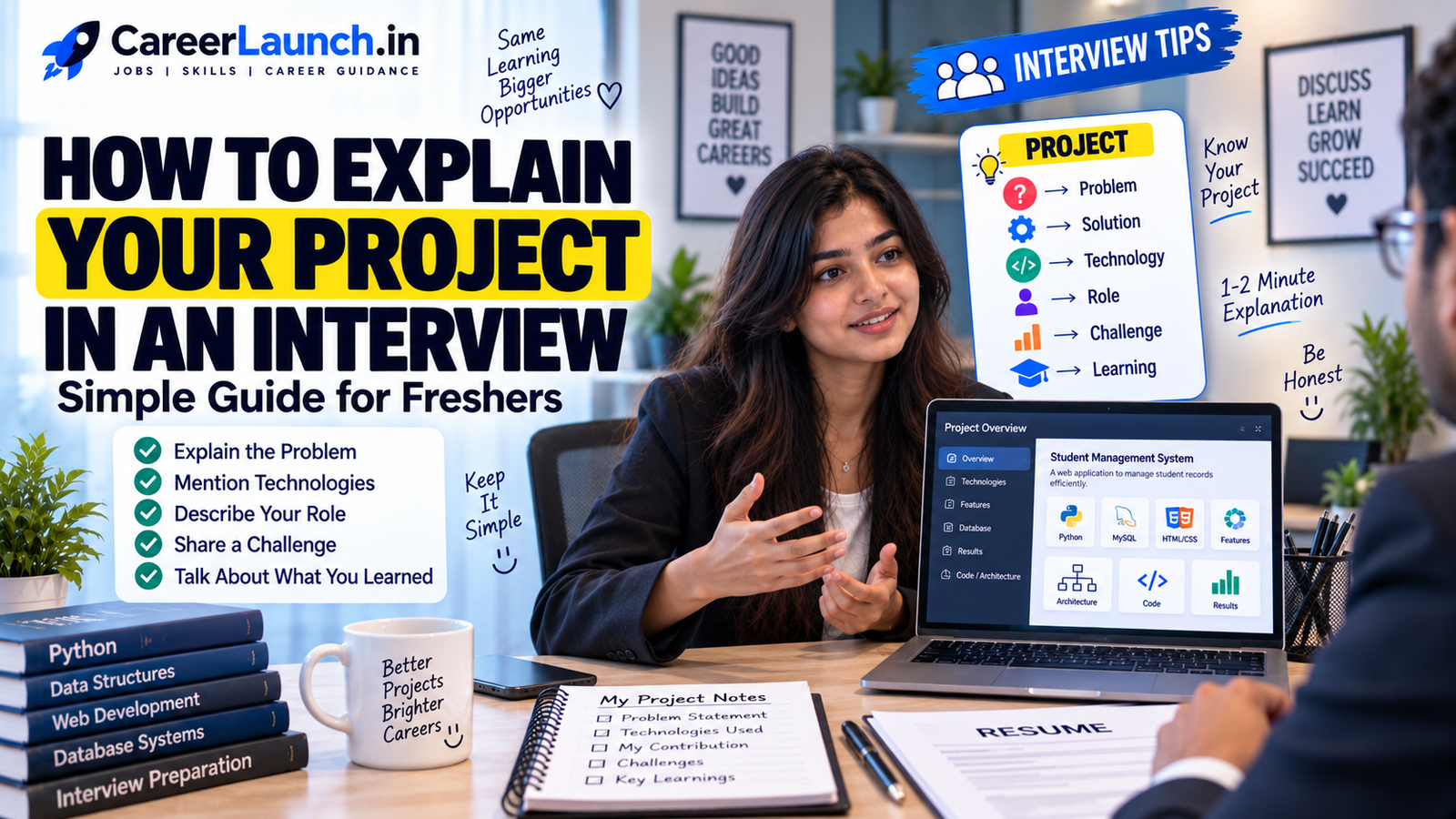
Your projects
Know your projects properly.
Be prepared to explain:
What the project does
Why you selected it
Your role
Technologies used
Problems you faced
What you learned
Your strengths
Choose two or three genuine strengths and have examples ready.
Your career plans
Think about:
The role you want
Skills you want to develop
Areas you want to learn
What kind of work interests you
Don’t Memorize HR Answers
This deserves special attention.
You can find hundreds of sample HR answers online.
The problem is that if you memorize one and repeat it exactly, it may sound unnatural.
For example:
“I am a highly motivated individual with exceptional interpersonal skills who thrives in challenging environments…”
Most freshers don’t actually talk like this.
Instead, use simple language.
Something like:
“I enjoy learning new things and I’m comfortable asking questions when I don’t understand something.”
sounds much more natural.
The interviewer is talking to you, not to a textbook.
A Simple Trick Before Your Interview
Take a sheet of paper and write answers to these 10 questions:
Tell me about yourself.
Why did you choose your degree?
Why do you want this job?
What are your strengths?
What is one weakness you’re working on?
Why should we hire you?
Tell me about your project.
Tell me about a challenge you faced.
Where do you see yourself in five years?
Do you have any questions for us?
Now read your answers aloud.
Don’t try to memorize every word.
Just remember the main points.
That way, your answer will sound like a conversation rather than a speech you learned the night before.
Final Thoughts
HR interviews can feel difficult when you’re a fresher because you may not have much professional experience to talk about.
But remember that the interviewer already knows you’re a fresher.
They aren’t expecting you to have five years of experience.
They want to understand who you are, how you communicate, how you think, whether you’re willing to learn, and whether you’re a good fit for the role.
So don’t try too hard to give “perfect” answers.
Be honest, keep your answers relevant and use examples from your college projects, internships, training or other genuine experiences.
And most importantly, don’t memorize someone else’s personality along with their answers.
Prepare your points, understand your own resume and speak naturally.
That’s usually a much better approach to an HR interview.