Getting your first IT interview call can feel exciting and stressful at the same time. You may start wondering what questions the interviewer will ask, whether your technical skills are enough, and what you should say if you do not know an answer.
If this is your first interview, you don’t need to know everything.
What matters is preparing well, understanding the role, being comfortable with your own resume, and showing the interviewer that you are willing to learn.
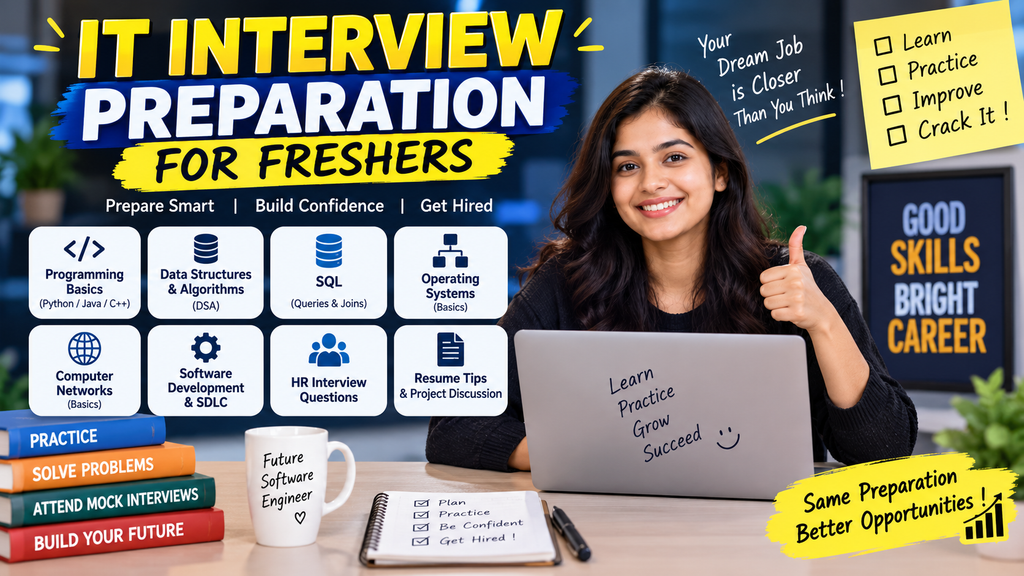
This guide covers some practical IT interview preparation tips for freshers that you can follow before attending your first interview.
First, Understand What the Company Is Looking For
Before you start preparing questions, read the job description carefully.
Look at the skills mentioned in the posting.
For example, if you’re applying for a software developer role and the company mentions:
Java
SQL
Data Structures
Object-Oriented Programming
Problem Solving
These should be part of your preparation.
You don’t have to become an expert in every skill mentioned in the job description. Start with the basics and make sure you can explain the concepts you have listed on your resume.
Also take a little time to learn about the company.
You should know:
What the company does
What products or services it offers
Which industry it works in
What the job role involves
Why you are interested in the position
This preparation can make a big difference when the interviewer asks, “Why do you want to join our company?”
Know Your Resume Before the Interview
This is one of the most important things for a fresher.
If something is written on your resume, be prepared to talk about it.
For example, if your resume says:
Java, Python, SQL, MySQL
the interviewer may ask you basic questions about any of these.
The same applies to projects.
If you have written:
Developed a Student Management System using Java and MySQL
you should be able to explain:
Why you built the project
What the project does
Which technologies you used
Your role in the project
What problems you faced
How you solved them
What you learned
Don’t add technologies or projects to your resume just because they sound impressive.
Your resume should represent what you actually know.
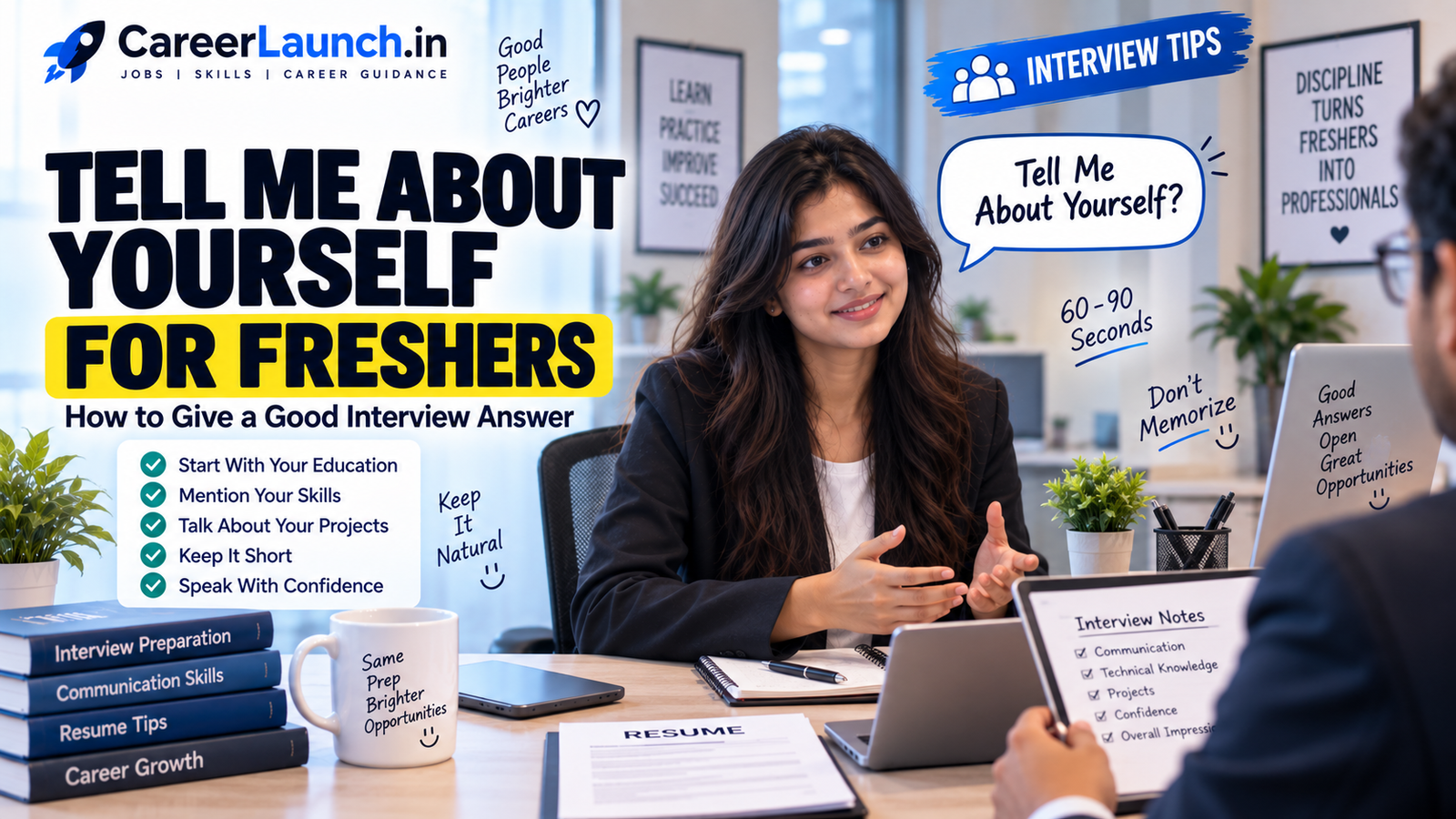
Prepare a Simple Self-Introduction
One of the first questions in many interviews is:
“Tell me about yourself.”
Don’t try to memorize a long speech.
Prepare a short introduction that covers your education, skills, projects, and what kind of opportunity you’re looking for.
Example
“Hi, I’m Rahul. I recently completed my B.Tech in Computer Science. I have worked with Java, SQL, and Python during my studies. I also completed a project on student expense tracking where I used Python and MySQL. I enjoy solving programming problems and learning new technologies. I’m currently looking for an entry-level software role where I can use my skills and continue learning.”
You can change this based on your background.
The goal is to sound like yourself instead of reciting a paragraph you memorized.
Revise the Basics of Your Main Programming Language
If you’re applying for a technical position, revise the programming language you know best.
For example, if Java is your strongest language, make sure you are comfortable with topics such as:
Variables and data types
Loops
Conditional statements
Arrays
Strings
Functions or methods
Classes and objects
Inheritance
Polymorphism
Exception handling
Collections
Basic coding problems
You may not be asked extremely difficult questions in every fresher interview.
However, you should be able to explain basic concepts clearly.
The interviewer may also give you a small coding problem and ask you to explain your approach.
Don’t Skip SQL
SQL is useful for many entry-level IT roles, not just database jobs.
Spend some time practicing:
SELECT statements
WHERE conditions
ORDER BY
GROUP BY
JOINs
Aggregate functions
Subqueries
Basic window functions
For example, you should understand what a query like this does:
SELECT department, COUNT(*) FROM employees GROUP BY department;
You should also be able to explain the difference between common joins such as INNER JOIN, LEFT JOIN, RIGHT JOIN, and FULL JOIN.
If SQL is mentioned in the job description, give it proper attention during your preparation.
Practice Basic DSA Questions
You don’t necessarily need to solve hundreds of difficult problems before your first interview.
Start with the fundamentals.
Practice questions involving:
Arrays
Strings
Searching
Sorting
Hashing
Stacks
Queues
Linked lists
Basic recursion
While practicing, don’t focus only on getting the correct output.
Try to understand:
What the problem is asking
How you would solve it
Why your approach works
How efficient your solution is
If you’re stuck, try explaining your thinking instead of staying completely silent.
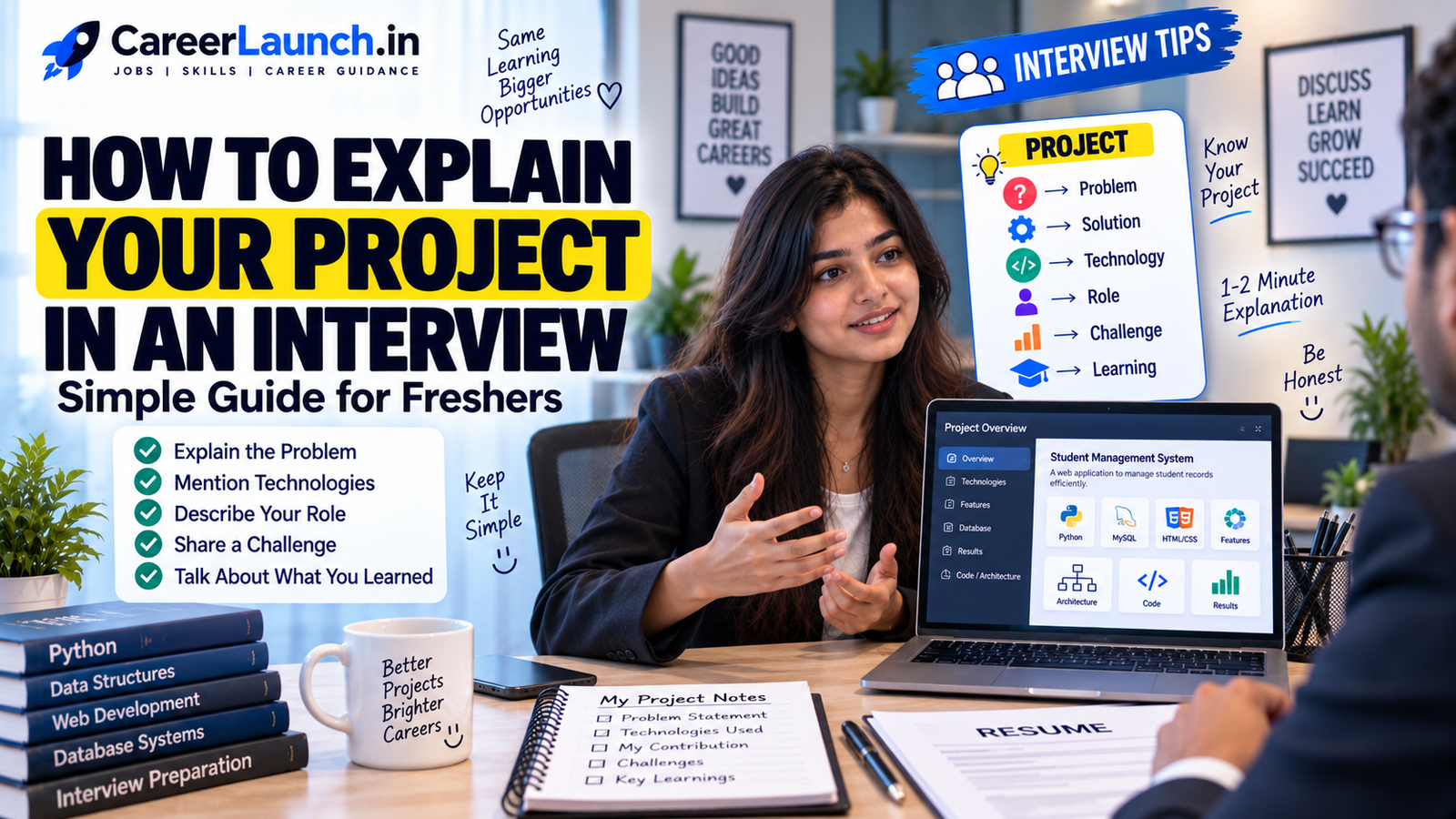
Be Ready to Explain Your Projects
Your projects can become one of the easiest ways to start a technical conversation.
Before the interview, choose your best one or two projects and revise them properly.
For each project, prepare answers to questions such as:
What was the project?
Explain it in simple words.
Why did you build it?
Tell the interviewer what problem you wanted to solve.
What technologies did you use?
Mention only the technologies you actually worked with.
What was your contribution?
If it was a team project, clearly explain what you personally handled.
What problem did you face?
Talk about a genuine problem and how you solved it.
What would you improve?
This is a good opportunity to show that you understand the limitations of your project.
What If You Don’t Know the Answer?
This is something many freshers worry about.
You won’t know every answer.
If you genuinely don’t know something, don’t make up an answer.
You can say:
“I’m not sure about that at the moment, but I’d like to learn it.”
Or:
“I haven’t worked with that yet, but I understand the basic concept.”
Being honest is much better than giving an incorrect answer confidently.
If you know part of the answer, explain what you do know.
Prepare for HR Questions Too
Technical preparation is important, but don’t ignore the HR round.
Some common questions include:
Tell me about yourself.
Prepare a short introduction.
Why do you want to join this company?
Give a genuine reason related to the company, role, or learning opportunity.
What are your strengths?
Choose strengths that you can support with an example.
For example:
“I learn new tools quickly. During my final-year project, I had to learn SQL, and I practiced it regularly to complete the database part of the project.”
What is one area you want to improve?
Choose something real and explain what you’re doing about it.
Where do you see yourself in a few years?
Keep your answer realistic. You can talk about developing your technical skills, taking more responsibility, and growing within your career.
Practice Speaking, Not Just Reading
You can spend hours reading interview questions and still feel nervous when someone actually asks you the question.
Try answering questions aloud.
You can practice with:
A friend
A college senior
A family member
A mock interview
Your phone’s voice recorder
Record yourself answering a few questions and listen to the recording.
You’ll quickly notice things such as:
Speaking too fast
Repeating the same words
Giving very long answers
Speaking too softly
Forgetting important points
This simple practice can improve your confidence.
What Should You Wear?
For an online interview, make sure you look presentable and your background is clean.
For an in-person interview, choose simple and professional clothing.
You don’t need expensive clothes.
The main goal is to look neat and comfortable.
Also keep these things ready if you’re attending an in-person interview:
Resume copies
Identification document if required
Educational documents if requested
Certificates if requested
Pen and notebook
Check the interview email carefully because the company may provide specific instructions.
Online Interview Checklist
If your interview is online, check everything before the scheduled time.
Test your:
Internet connection
Laptop or computer
Camera
Microphone
Headphones
Charging
Interview application
Find a quiet place where you won’t be interrupted.
Join the meeting a few minutes early rather than logging in at the last second.
A Simple 3-Day Interview Preparation Plan
If you only have a few days before your interview, don’t panic.
Day 1: Technical Basics
Revise your main programming language, SQL, OOP, and basic computer science concepts.
Spend some time solving easy and medium coding questions.
Day 2: Resume and Projects
Go through your resume carefully.
Revise your projects, internships, certifications, and anything else you have mentioned.
Practice explaining your projects without reading from your resume.
Day 3: Interview Practice
Practice your introduction and common HR questions.
Do a mock interview if possible.
Also research the company and read the job description one more time.
The night before the interview, get enough rest instead of studying until very late.
Common Mistakes Freshers Should Avoid
1. Memorizing every answer
Interviewers may change the wording of a question.
Understanding the concept is more useful than memorizing a sentence.
2. Adding fake skills
Only mention skills you can discuss.
3. Ignoring the job description
The job description tells you what the company is looking for.
4. Giving extremely long answers
Answer the question first, then add details when necessary.
5. Speaking too quickly
Take a second to think before answering.
6. Being afraid to say “I don’t know”
It’s completely normal not to know everything as a fresher.
7. Not asking any questions
At the end of an interview, you may be asked:
“Do you have any questions for us?”
Have one or two genuine questions ready.
For example:
“What would the first few months look like for someone joining this role?”
Questions You Can Ask the Interviewer
If the interviewer gives you an opportunity to ask questions, you can ask about the actual role.
Some examples:
What would be the main responsibilities in this position?
What technologies does the team work with?
What does the initial training look like?
What kind of projects would a fresher usually work on?
How does the team support new employees during the first few months?
Avoid asking questions that are already clearly answered in the job description.
Your First Interview Does Not Have to Be Perfect
Your first interview is also a learning experience.
You might not answer every question correctly. You might get nervous. You might even forget something you knew while preparing.
That’s okay.
After the interview, write down:
Questions you were asked
Questions you couldn’t answer
Coding problems you received
Topics you need to revise
Things you would answer differently next time
Then use that information to prepare for your next interview.
Every interview can teach you something.
First IT Interview Checklist
Before you join the interview, ask yourself:
Technical
☐ Have I revised my main programming language? ☐ Have I practiced basic SQL? ☐ Have I revised OOP and DSA fundamentals? ☐ Can I explain my projects?
Resume
☐ Is everything on my resume accurate? ☐ Can I explain every skill I listed? ☐ Are my project details clear?
Company
☐ Did I read the job description? ☐ Do I know what the company does? ☐ Do I understand the role I’m applying for?
Interview
☐ Have I practiced my introduction? ☐ Have I practiced common HR questions? ☐ Have I prepared a few questions to ask?
Online interview
☐ Is my internet working? ☐ Is my camera working? ☐ Is my microphone working? ☐ Is my laptop charged? ☐ Do I have a quiet place for the interview?
Final Thoughts
Preparing for your first IT interview doesn’t mean studying everything in computer science.
Start with the job description, understand your resume, revise the fundamentals, and practice explaining what you know.
Most importantly, don’t try to pretend that you know something when you don’t.
As a fresher, companies also look at how you communicate, how you approach a problem, and how willing you are to learn.
Your first interview may not go exactly as planned, but that’s part of the process. Take notes, learn from each interview, and keep improving.
The goal isn’t to give a perfect answer to every question.
The goal is to show that you’re prepared, honest, curious, and ready to learn.
Career Launch Tip 💡
If you’re preparing for your first IT job, don’t spend all your time solving difficult coding problems.
Take a balanced approach. Revise your fundamentals, build a couple of projects you can explain properly, practice SQL and coding questions, and work on your communication.
And when you apply for a job, read the job description before starting your preparation. It can tell you a lot about the skills and knowledge you are likely to need.