Can You Get a Job Without Work Experience? Resume for freshers Guide:
Getting your first job can feel confusing, especially when you open a resume template and see sections asking for “Work Experience.”
If you’re a fresher, you may be wondering:
“What am I supposed to write when I haven’t worked anywhere yet?”
The good news is that you don’t need a long work history to create a strong resume.
As a fresher, your resume can focus on what you have learned, the projects you have worked on, the skills you have built, and the kind of role you are looking for.
A simple, well-organized resume can help recruiters quickly understand your background and decide whether your profile is worth considering.
In this guide, we’ll look at how to create a fresher resume even if you have no previous work experience.
What Should a Fresher Put on a Resume?
For resume for freshers, You may not have professional experience yet, but you probably have more to show than you think.
A resume for freshers can include:
Name and contact details
A short professional summary
Education
Technical or professional skills
Academic or personal projects
Internships
Certifications
Hackathons or competitions
Achievements
Relevant coursework
Coding or professional profiles
You don’t need to include every possible section.
The idea is to include information that is relevant to the job you’re applying for.
For example, if you’re applying for a software developer position, your programming languages, projects, GitHub work, and computer science fundamentals may be more useful than a long list of unrelated activities.
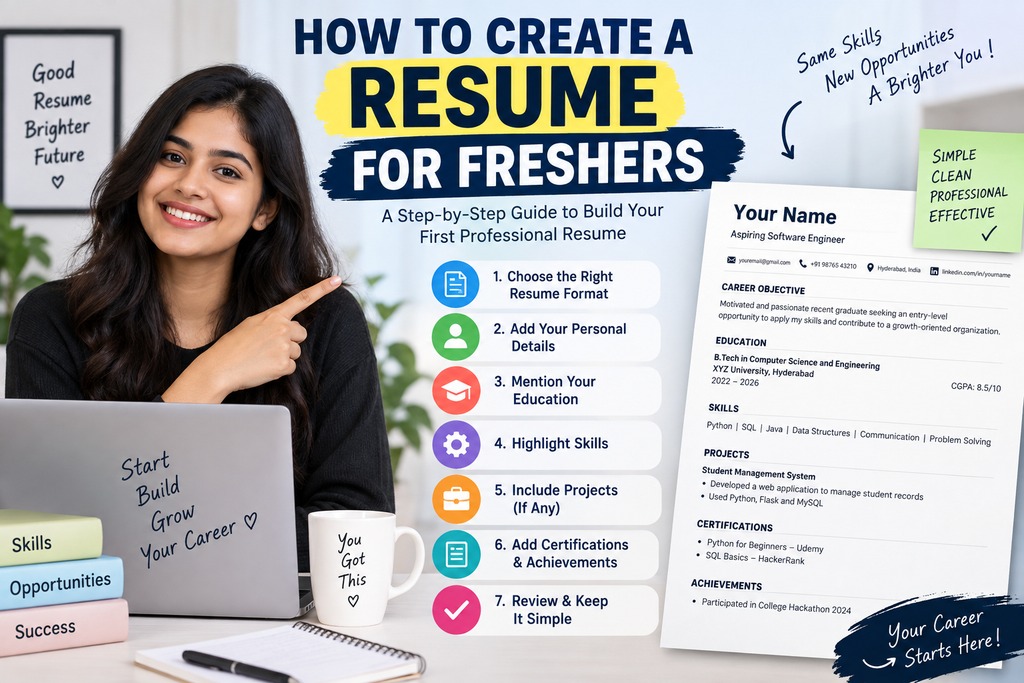
How to Build a Fresher Resume Step by Step
Let’s go through each section so you know exactly what to write.
1. Start With Your Name and Contact Details
Your name should be easy to find at the top of the resume.
Below it, add the contact information a recruiter may need.
looks much better on a job application than an old email address with random numbers or nicknames.
2. Write a Short Resume Summary
A resume summary is a short introduction about your profile.
Don’t make it five or six lines long.
For a fresher, around 2-4 lines is usually enough.
Example
Computer Science graduate with hands-on experience in Python, SQL, and web development through academic and personal projects. Interested in software development and looking for an entry-level opportunity to apply technical skills while learning from an experienced engineering team.
Notice that this doesn’t say:
“I am a hardworking and passionate individual looking for a challenging opportunity…”
That type of sentence is very common and doesn’t tell the recruiter much.
Instead, mention your actual skills and the type of job you’re targeting.
3. Add Your Education
For freshers, education is an important part of the resume because you may not have professional experience to show yet.
A simple format works well.
Example
B.Tech – Computer Science and Engineering ABC Institute of Technology, Hyderabad 2022 – 2026 CGPA: 8.4/10
Intermediate XYZ Junior College 2020 – 2022 Percentage: 88%
You don’t necessarily need to include every school-level detail.
Give more space to your highest and most relevant qualification.
If you’re applying for your first IT job, your degree, branch, graduation year, and academic performance can be useful information.
4. Add Your Skills
Don’t create a huge list of technologies just because you’ve seen them online.
Only mention skills that you actually understand and can discuss during an interview.
For example:
Technical Skills
Programming: Python, Java Database: SQL, MySQL Web: HTML, CSS, JavaScript Tools: Git, GitHub Concepts: Data Structures, OOP
This is much easier for a recruiter to scan than a paragraph containing 20 different technologies.
One important rule
Don’t lie on your resume.
If you’ve only watched a few tutorials about a technology, don’t present yourself as an expert.
Recruiters can ask questions about anything you list.
5. Your Projects Can Replace Missing Work Experience
This is one of the most important sections for a fresher.
If you don’t have a job history, projects can show what you can actually build or work with.
You can include:
College projects
Final-year projects
Personal projects
Open-source contributions
Hackathon projects
Small applications you built while learning
Example
Student Expense Tracker
Technologies: Python, SQL, HTML, CSS
Built a simple application to record and categorize daily expenses.
Used SQL to store and retrieve transaction data.
Added basic reports to help users understand their monthly spending.
Designed a simple interface for adding and viewing expenses.
This is much stronger than simply writing:
Project: Expense Tracker
Technologies: Python, SQL
Give the recruiter enough information to understand what you built and what you personally worked on.
6. How Many Projects Should You Add?
You don’t need ten projects.
For most freshers, 2-4 relevant projects can be enough.
Choose projects that:
Match the job you’re applying for
Use technologies mentioned in the job description
You can explain confidently
Show some practical problem-solving
Have a clear purpose
For example, if you’re applying for a Data Analyst position, projects involving SQL, Excel, Power BI, Python, or data analysis can be more relevant than a random web development project.
7. Don’t Forget Internships
If you’ve completed an internship, even a short one, include it.
You can write:
Data Analyst Intern – ABC Company June 2025 – August 2025
Worked with Excel and SQL to clean and organize data.
Prepared basic reports for the team.
Assisted with data validation and documentation.
Keep the points focused on what you actually did.
If your internship was unpaid, you can still list it as experience if it was a genuine internship.
8. Certifications Can Help – But Don’t Overdo Them
Certifications can be useful when you’re starting your career, particularly when they relate to the position you’re applying for.
Examples:
AWS Cloud Practitioner
Microsoft certifications
Google certifications
SQL certifications
Python certifications
Data analytics certifications
But don’t fill half your resume with certificates.
If you’ve completed 20 online courses, you don’t need to list all 20.
Choose the ones that are relevant and meaningful for the job.
9. Add GitHub or Coding Profiles When They Actually Help
If you’re applying for a technical role and have useful work on GitHub, adding your profile can be a good idea.
For software roles, you can also include relevant coding profiles such as:
GitHub
LeetCode
HackerRank
CodeChef
But make sure the profiles are presentable.
If your GitHub has no projects or your profile contains unfinished test repositories, you may want to clean it up before adding the link.
10. Should Freshers Include Hobbies?
Usually, hobbies don’t need much space on a professional resume.
You can leave them out unless they add something useful to your profile.
For example, if you’re applying for a technical job, the recruiter will generally get more value from seeing your projects, skills, internship experience, or certifications.
Your resume has limited space, so use that space carefully.
Computer Science graduate with knowledge of Python, SQL, and web development. Built academic and personal projects involving data handling and application development. Looking for an entry-level software development opportunity.
Education
B.Tech – Computer Science and Engineering ABC Institute of Technology 2022 – 2026 | CGPA: 8.4/10
Built an application for recording and organizing personal expenses.
Used SQL for storing and retrieving transaction data.
Added basic monthly expense reports.
College Event Management System Java | MySQL
Developed a basic system for managing college event registrations.
Used MySQL to store student and event information.
Implemented features for registration and record management.
Internship
Software Development Intern – ABC Technologies
Assisted with application testing and bug fixing.
Worked with the development team on assigned tasks.
Used Git for basic version-control activities.
Certifications
Python Programming – XYZ Academy
SQL Fundamentals – XYZ Platform
Achievements
Participated in a college-level hackathon.
Completed multiple coding projects during college.
How Long Should a Fresher Resume Be?
For most fresh graduates, one page is a good starting point.
You don’t need to make your resume two or three pages just to make it look impressive.
Recruiters often have many applications to review, so a clear resume that gets to the point can be easier to read.
If you have several years of relevant experience later in your career, a longer resume may make sense.
But when you’re applying for your first job, focus on quality rather than length.
Common Resume Mistakes Freshers Make
A few small mistakes can make an otherwise good resume look less professional.
Avoid these:
Using the same resume for every job
If you’re applying for a Data Analyst position, highlight relevant data skills and projects. For a software developer position, your programming and development experience may deserve more attention.
Adding skills you don’t know
Don’t copy the skills section from a job description and paste it into your resume.
Writing long paragraphs
Use short bullet points wherever possible.
Including unnecessary personal information
You generally don’t need to include details such as your parents’ names, religion, marital status, or a full home address.
Using a complicated design
A simple layout is often easier to read and works well with applicant tracking systems.
Ignoring spelling mistakes
Read your resume once before sending it.
Better still, ask someone you trust to read it.
Adding fake experience
Never invent an internship, project, certification, or job.
It may look good on paper, but you could be asked about it during an interview.
Should You Customize Your Resume for Every Job?
Yes, whenever possible.
You don’t need to rewrite your entire resume every time.
Instead, compare your resume with the job description and make small changes.
For example, suppose a company is hiring a Junior Data Analyst and mentions:
SQL
Excel
Power BI
Data Analysis
If you already have these skills, make sure they’re easy to find on your resume.
You could also move a relevant data project higher on the page.
This makes your resume more relevant to the position.
Quick Resume Checklist for Freshers
Before you send your resume, take two minutes and check:
☐ Is my name and contact information correct? ☐ Is my email address professional? ☐ Is my graduation year correct? ☐ Have I listed my relevant skills? ☐ Have I included 2–4 useful projects? ☐ Can I explain everything written on my resume? ☐ Have I checked for spelling mistakes? ☐ Is the formatting consistent? ☐ Is the file easy to read? ☐ Did I save the final version in PDF if the application asks for it? ☐ Did I tailor the resume to the job?
If you can answer yes to these questions, your resume is ready for another look.
What Matters Most When You Have No Experience?
Don’t think of your lack of work experience as having “nothing to show.”
As a student or recent graduate, your projects, skills, education, internships, certifications, and problem-solving ability can tell recruiters a lot about you.
The key is to present those things clearly and honestly.
You don’t need a fancy resume.
You need a resume that makes it easy for someone to understand who you are, what you know, what you’ve worked on, and what kind of opportunity you’re looking for.
Final Thoughts
Creating your first resume can feel difficult because you don’t have years of experience to talk about. That’s completely normal.
Start with the things you already have – your education, projects, skills, internships, certifications, and achievements. Then organize them in a clean format and adjust the important sections when you apply for different roles.
And remember: your resume doesn’t need to prove that you’re already an expert.
For a fresher, it should show that you have a good foundation, that you’ve made an effort to learn, and that you’re ready to grow.
💡 Career Launch Tip
Before applying for your next fresher job, open the job description and compare it with your resume.
Pick 2-3 important skills mentioned by the employer that you genuinely know, and make sure they’re clearly visible in your resume. If you have a project using one of those skills, mention that project too.
That small check takes only a few minutes and can make your application much more relevant.